Posted by Aham Emmanuel
19 Jun, 2026
Nigeria Averts Fertiliser Crisis With Early Intervention
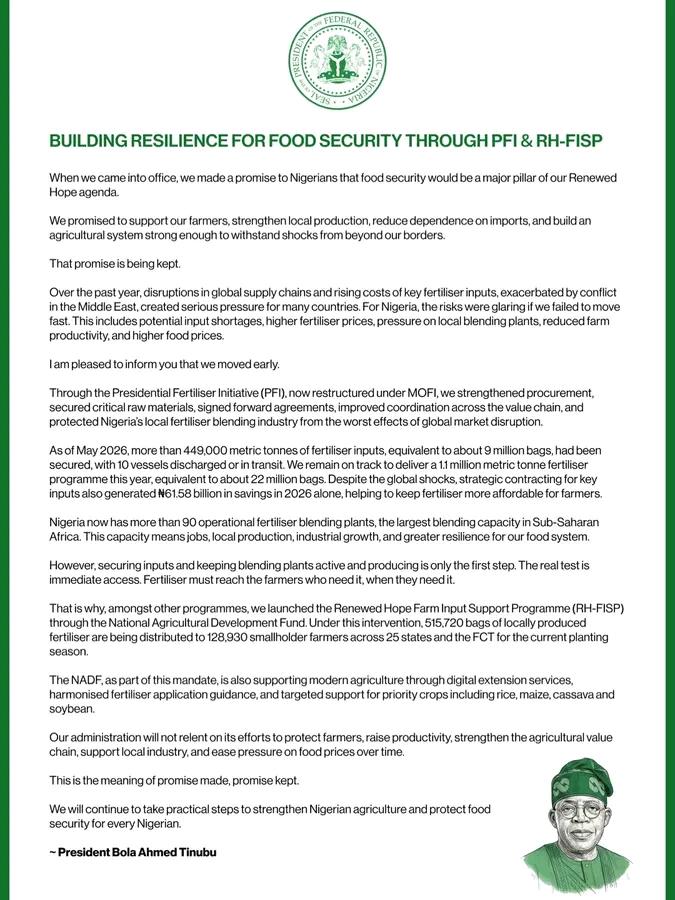
President Bola Ahmed Tinubu has detailed how Nigeria narrowly escaped what could have been a devastating fertiliser crisis in 2026. With global supply chains under immense pressure, rising input costs, and conflict in the Middle East threatening to choke off supplies, the outlook for Nigerian farmers was grim. Higher fertiliser prices would have meant lower yields, reduced productivity, and mounting food inflation for millions of households.
Tinubu explained that his administration acted decisively and early, deploying the Presidential Fertilizer Initiative (PFI) — now restructured under MOFI — to secure critical supplies and keep Nigeria’s blending plants running. This intervention was not only about preventing shortages but also about protecting the foundation of Nigeria’s agricultural sector, ensuring that farmers had the tools they needed to sustain the nation’s food basket.
Key Achievements Under PFI
- 449,000+ metric tonnes of fertiliser inputs secured — equivalent to about 9 million bags for blending plants
- 10 vessels discharged or in transit, guaranteeing steady inflow of raw materials despite global disruptions
- 1.1 million metric tonnes production targeted for 2026, signaling long‑term planning beyond immediate needs
- 22 million bags expected this year to meet farmer demand across the country
- ₦61.58 billion saved through strategic contracting and efficient procurement, freeing resources for other priorities
- 90+ blending plants protected nationwide, reinforcing Nigeria’s status as sub‑Saharan Africa’s largest fertiliser blending hub
Tinubu stressed that these measures were critical in shielding Nigeria’s domestic production capacity from external shocks. By keeping blending plants active, the administration ensured that Nigeria did not become overly dependent on volatile international markets.
Renewed Hope Farm Input Support Programme
Complementing the PFI, the government rolled out the Renewed Hope Farm Input Support Programme, designed to deliver fertiliser directly to farmers at the grassroots level.
- 515,720 bags currently being distributed nationwide
- 128,930 smallholder farmers targeted for direct support
- Coverage across 25 states + FCT, ensuring broad national reach
- 5,040 farmers per state, with 20,160 bags per state allocated
- Priority crops: rice, maize, cassava, and soybean, staples that anchor Nigeria’s food security
This dual strategy — securing inputs at scale while ensuring last‑mile delivery — reflects Tinubu’s broader vision of food security in practice. It is not just about stockpiling fertiliser but about ensuring it reaches the hands of farmers who need it most, thereby raising productivity and easing pressure on food prices.
A Promise Made, A Promise Kept
Tinubu framed the intervention as proof of his administration’s commitment to Nigeria’s agricultural future. “This is what food security looks like in practice,” he declared, underscoring that proactive measures are being implemented across the value chain — from securing inputs to sustaining production and delivering support directly to farmers.
By acting early, Nigeria avoided a crisis that could have destabilized its food system. Instead, the country has reinforced its agricultural resilience, protected millions of farmers, and laid the groundwork for stronger productivity in the years ahead.